
Jobs to Be Done Keywords in SEO: The Ultimate Guide for High-Intent Traffic

Introduction
If you’re still doing keyword research the old way—volume, difficulty, and rankings—you’re leaving money on the table.
Because here’s the truth: people don’t search for keywords, they search to get something done.
That’s where jobs to be done keywords come in.
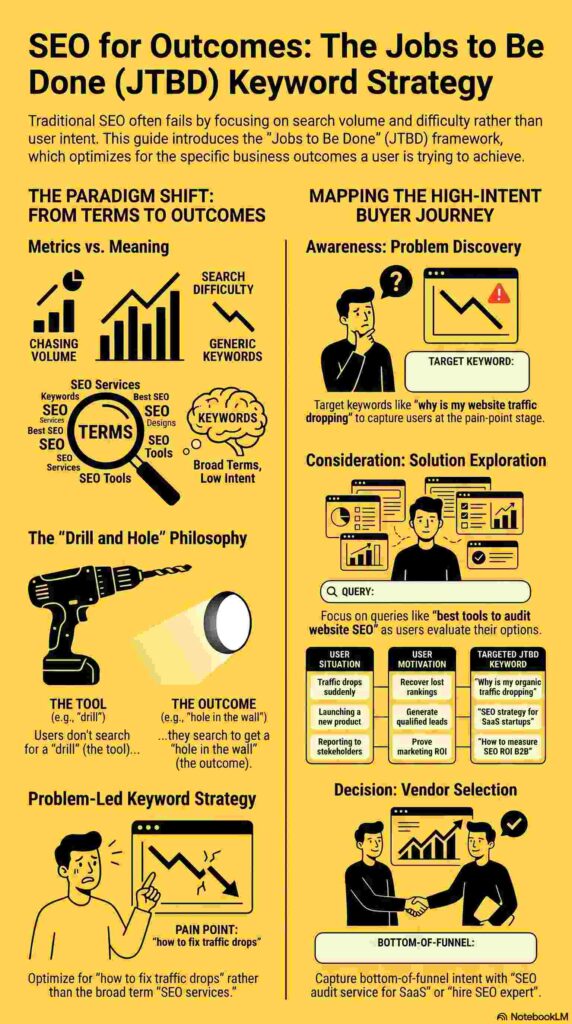
Think of it like this: when someone buys a drill, they don’t want a drill—they want a hole in the wall. SEO works the same way. Users don’t want “SEO services,” they want “more qualified leads,” “better rankings,” or “fix traffic drops.”
This shift—from keywords to intent—is what separates average SEO from revenue-driving SEO.
In this guide, you’ll learn how to:
- Find jobs to be done keywords
- Map them to the buyer journey
- Create content that converts (not just ranks)
1. What Are Jobs to Be Done Keywords?
Jobs to be done keywords are search queries that reflect what a user is trying to accomplish—not just what they’re searching for.
Instead of:
- “SEO tools”
You target:
- “how to find technical SEO issues on website”
- “best way to audit website for SEO errors”
Key idea:
You’re optimizing for outcomes, not just terms.
2. Why Traditional Keyword Research Falls Short
Most SEO workflows focus on:
- Search volume
- Keyword difficulty
- SERP competition
But here’s the problem:
These metrics don’t capture intent depth.
Example:
- “SEO” → high volume, low clarity
- “how to recover from Google penalty” → lower volume, high intent
Which one converts better?
Always the second.
Insight:
Low-volume JTBD keywords often drive higher pipeline value.
3. Understanding the Jobs to Be Done Framework
The Jobs to Be Done (JTBD) framework focuses on:
- What triggers a search
- What outcome the user wants
- What success looks like
A JTBD statement looks like:
“When I [situation], I want to [motivation], so I can [expected outcome].”
Example:
- When traffic drops, I want to identify SEO issues so I can recover rankings.
This is exactly how people search.
4. Jobs to Be Done Keywords Examples
Here are practical jobs to be done keywords examples across different SEO scenarios:
Awareness Stage
- “why is my website traffic dropping”
- “why pages not indexing in Google”
- “what causes keyword ranking drop”
Consideration Stage
- “how to fix technical SEO issues”
- “tools to audit website SEO”
- “best way to improve page speed SEO”
Decision Stage
- “SEO audit service for SaaS”
- “technical SEO consultant pricing”
- “hire SEO expert for B2B company”
Pattern:
These keywords are problem-led, not keyword-led.
5. Jobs to Be Done Examples in SEO Context
Let’s break real jobs to be done examples:
Example 1: SaaS Founder
- Job: Increase demo signups
- Keywords:
- “how to generate SaaS leads organically”
- “SEO strategy for SaaS startups”
Example 2: E-commerce Manager
- Job: Increase product visibility
- Keywords:
- “why product pages not ranking”
- “how to optimize Shopify product SEO”
Example 3: Marketing Head
- Job: Prove ROI
- Keywords:
- “SEO reporting dashboard examples”
- “how to measure SEO ROI B2B”
Insight:
Each keyword maps directly to a business outcome.
6. Types of Jobs to Be Done Keywords
1. Problem-Based Keywords
Focus on pain points
- “why organic traffic dropped suddenly”
2. Solution-Based Keywords
Focus on fixes
- “how to fix crawl errors”
3. Outcome-Based Keywords
Focus on results
- “increase website conversions SEO”
4. Tool/Comparison Keywords
Focus on evaluation
- “best SEO audit tools for agencies”
5. Decision Keywords
Focus on buying intent
- “SEO services for B2B companies”
7. Mapping JTBD Keywords to the Buyer Journey
| Stage | JTBD Focus | Keyword Example |
|---|---|---|
| Awareness | Problem discovery | “why rankings dropped” |
| Consideration | Solution exploration | “how to fix SEO issues” |
| Decision | Vendor selection | “SEO agency for SaaS” |
Key takeaway:
Each stage needs different content types.
8. How to Find Jobs to Be Done Keywords
1. Google Search Console
Look at:
- Queries with impressions but low CTR
- Long-tail queries
2. Customer Interviews
Ask:
- What triggered your search?
- What problem were you solving?
3. Sales Calls
Extract:
- Objections
- Pain points
4. Reddit & Communities
Look for:
- Real problems
- Unfiltered language
5. Competitor Analysis
Identify:
- Content gaps
- Missing intent coverage
9. Using Customer Data to Discover JTBD
Data sources you should use:
- GSC → actual queries
- GA4 → behavior flow
- CRM → conversion keywords
- Support tickets → recurring issues
Validation method:
- Map keyword → landing page → conversions
- Track assisted conversions in GA4
10. Content Strategy Using JTBD Keywords
Instead of writing:
- “SEO Guide”
Write:
- “How to Fix SEO Issues After Website Migration”
Content Framework
- Problem
- Cause
- Solution
- Tools
- Outcome
Result:
Higher engagement + better conversions.
11. JTBD Keywords for B2B SEO
In B2B, JTBD is even more powerful because:
- Buying cycles are longer
- Multiple stakeholders involved
- Decisions are outcome-driven
Examples
- “how to scale organic traffic for SaaS”
- “enterprise SEO challenges and solutions”
- “SEO strategy for AI companies”
Focus:
Tie keywords to revenue impact.
12. Measuring Success of JTBD SEO
Forget vanity metrics.
Track:
- Qualified traffic (GSC + CRM mapping)
- Conversion rate by keyword cluster
- Pipeline contribution
Advanced Tracking
- Use:
- UTM tagging
- CRM attribution
- Assisted conversions
13. Common Mistakes to Avoid
1. Chasing Volume
High volume ≠ high intent
2. Ignoring Context
Same keyword, different intent
3. Writing Generic Content
No differentiation
4. Not Mapping to Funnel
Leads to traffic without conversions
14. Future of SEO: From Keywords to Intent
Search is evolving:
- AI answers
- Zero-click results
- Conversational queries
What wins now:
- Clear intent
- Structured content
- Authority signals
JTBD keywords are future-proof because they align with:
- Human thinking
- AI understanding
15. Action Plan to Implement Today
Step 1: Audit Existing Keywords
Identify:
- Low CTR queries
- High impressions, low conversions
Step 2: Map JTBD
Convert keywords into:
- Problems
- Outcomes
Step 3: Create Content
Focus on:
- Solving real problems
Step 4: Track Results
Measure:
- Conversions, not rankings
Conclusion
SEO is no longer about ranking for keywords—it’s about solving problems.
Jobs to be done keywords help you:
- Capture real intent
- Attract qualified traffic
- Drive actual business results
If you shift your strategy from “what people search” to “what people want to achieve,” you won’t just rank—you’ll convert.
And that’s what modern SEO is all about.
FAQs
1. What are jobs to be done keywords in SEO?
Jobs to be done keywords are search queries that reflect what a user wants to accomplish, focusing on outcomes rather than just terms.
2. How are JTBD keywords different from traditional keywords?
Traditional keywords focus on volume and ranking, while JTBD keywords focus on intent, problems, and desired outcomes.
3. How do I find jobs to be done keywords?
Use sources like Google Search Console, customer interviews, sales calls, and community platforms to identify real user problems and needs.
4. Are jobs to be done keywords useful for B2B SEO?
Yes, they are highly effective in B2B because they align with business goals, decision-making processes, and long buying cycles.
5. How do I measure success with JTBD keywords?
Track qualified traffic, conversions, and pipeline impact using tools like GA4, CRM systems, and attribution models.

Related Posts

Non-Commodity Content in SEO: The Only Strategy That Survives 2026

SEO for Manufacturing Companies: How to Ace the SEO Game