
Non-Commodity Content in SEO: The Only Strategy That Survives 2026
Introduction
If you’ve been watching search results lately, you’ve probably noticed something strange: rankings are unstable, traffic is unpredictable, and AI-generated “content slop” is everywhere. Pages that used to rank with generic advice are quietly disappearing.
That’s not accidental.
Google has been very clear through recent statements: it now prioritizes unique, authentic, non-commodity content. In simple terms, if your content looks like something anyone—or any AI—can generate, it’s losing value fast.
Here’s the shift:
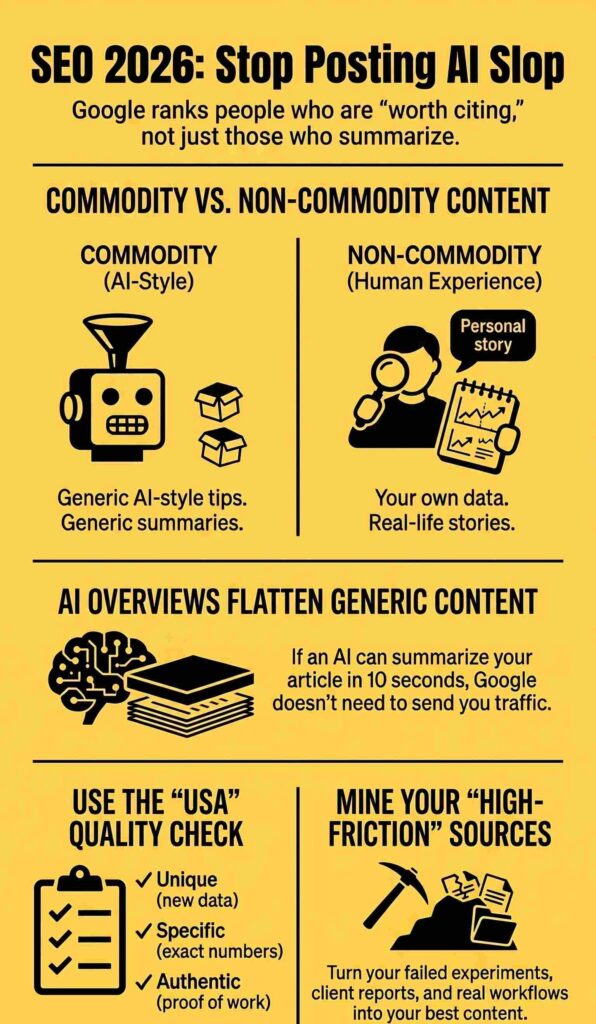
- Commodity content = summarized, generic, repeatable
- Non-commodity content = original, experience-driven, hard to replicate
And this isn’t just about rankings anymore. With AI Overviews and answer engines rising, only non-commodity content gets cited.
This article breaks down what non commodity content in SEO actually means, why it’s dominating 2026, and how you can build it consistently—without burning time or resources.
What Is Commodity Content vs. Non-Commodity Content?
Let’s simplify this with a clear comparison:
| Aspect | Commodity Content | Non-Commodity Content |
|---|---|---|
| Source | Generic tips, public data, AI summaries | First-hand experience, proprietary data, original analysis |
| Style | Listicles, “7 tips for…”, broad overviews | Case studies, breakdowns, unique opinions |
| Replicability | Anyone (or AI) can recreate it | Only you or your team can produce it |
Real Example
- Commodity: “7 Tips for First-Time Homebuyers”
- Non-Commodity: “How I won a bidding war last week by waiving inspection—and when you should NOT do it”
The difference is simple:
One is information. The other is experience + decision-making context.
Why This Term Matters Now
Google isn’t just ranking content anymore—it’s filtering what deserves attention in an AI-driven world.
Commodity content is:
- Easy to generate
- Easy to ignore
- Easy for AI to summarize
Non-commodity content is:
- Hard to replicate
- Valuable to users
- Worth citing
That’s the entire game shift.
Why Non-Commodity Content Is Critical for SEO in 2026
1. AI Overviews Flatten Commodity Content
AI doesn’t need your “10 tips” article. It can generate that instantly.
But it cannot generate your real-world data, decisions, or failures.
2. Citation Economy Has Begun
Search is moving from ranking pages → citing sources.
Only content with:
- Original insights
- Clear expertise
- Named examples
…gets referenced.
3. Better Business Impact
From a revenue lens:
- Higher CTR: Unique content creates curiosity
- Better conversion: Real examples build trust
- Stronger E-E-A-T: Experience is now a ranking layer
- Future-proofing: Resistant to algorithm volatility
Validation (No Guesswork)
To prove this in your own stack:
- Compare GSC CTR on generic vs case-study pages
- Track time on page (GA4)
- Check assisted conversions (CRM or GA4)
- Analyze backlinks to original research pages (Ahrefs)
You’ll see the pattern fast.
Google’s Shift Toward Unique Content
The Helpful Content system is no longer a “system”—it’s embedded into ranking signals.
Google now prefers:
- Experience over summaries
- Insights over repetition
- Proof over claims
Think of it like this:
Commodity content is like stock photos.
Non-commodity content is like your own camera roll.
Which one do you trust more?
Trait 1: Unique Content
What It Means
Content that adds something new—data, perspective, or insight.
Bad Example
“SEO is important for business growth.”
Good Example
“We analyzed 42 SaaS landing pages and found that pages with comparison sections had 31% higher conversion rates.”
How to Add It
- Run small experiments
- Share internal findings
- Add contrarian opinions
Trait 2: Specific Content
What It Means
Content tied to real situations—not generic advice.
Bad Example
“Use keywords in your content.”
Good Example
“We moved a keyword from H2 to title tag and saw a 18% CTR increase in 14 days.”
How to Add It
- Use exact numbers
- Mention timelines
- Describe context
Trait 3: Authentic Content
What It Means
Content that proves real experience.
Bad Example
“Content marketing works.”
Good Example
“This blog generated 312 leads in 90 days—here’s the funnel breakdown.”
How to Add It
- Screenshots (GSC, GA4)
- Real workflows
- Personal insights
How to Create Non-Commodity Content: A Practical Framework
This is where most people fail—they understand the concept but can’t execute.
Here’s a repeatable system:
1. Mine High-Friction Sources
Look where effort exists:
- Client work
- Failed experiments
- Sales objections
- Internal reports
These are gold.
2. Turn Work Into Content
Instead of creating new ideas, document:
- “What we did”
- “What worked”
- “What failed”
3. Add Original Analysis
Even small datasets work.
Example:
- Analyze 10 pages → publish insights
- Compare 3 tools → share results
4. Use AI the Right Way
AI should:
- Structure content
- Summarize research
But NOT:
- Replace your thinking
- Generate final insights
5. Structure for Humans + AI
- Clear headings
- Named entities
- Bullet points
- Scannable flow
6. Prove Everything
Add:
- Screenshots
- Data points
- Examples
No proof = commodity.
Using AI Without Creating Commodity Content
AI is not the problem—lazy usage is.
Wrong Approach
“Write article on SEO tips”
Right Approach
“Structure article around my case study data + insights”
Rule
AI handles speed. You handle depth.
Content Formats That Work in 2026
Some formats naturally become non-commodity:
- Case studies
- Original research
- “What worked / what didn’t” posts
- Tool breakdowns (from real use)
- Industry teardown articles
If you’re building topical authority, prioritize these.
Common Mistakes That Create Commodity Content
Even experienced SEOs fall into this trap:
- Rewriting top-ranking pages
- Publishing high volume, low depth
- Using AI without adding insight
- Writing “best practices” without proof
Quick Audit Framework
Ask:
- Can AI generate this?
- Is there real data?
- Is this specific?
- Does this show experience?
If most answers are “no” → it’s commodity.
Real-World Examples & Quick Wins
Example 1: B2B SaaS Blog
Before: Generic “SEO tips” content
After: Case studies + funnel breakdowns
Result: Higher qualified leads (validated via CRM attribution)
Example 2: Local SEO Client
Before: Generic service pages
After: Location-based case insights + reviews
Result: Increased calls and direction requests (GMB insights)
Example 3: Publisher Site
Before: High-volume AI content
After: Expert-written breakdowns
Result: Improved rankings post-core updates
Conclusion & Actionable Next Steps
Non-commodity content isn’t about working harder—it’s about working smarter.
Instead of competing on volume, you compete on originality, specificity, and proof.
What You Should Do This Week
- Pick 1 existing blog
- Add real data, examples, or insights
- Remove generic fluff
- Track CTR and engagement
Because in 2026, SEO isn’t just about ranking.
It’s about being worth citing.
FAQs
1. What is non commodity content in SEO?
It refers to content that includes unique insights, real experience, and original data that cannot be easily replicated by others or AI.
2. Why is commodity content losing rankings?
Because AI can generate and summarize it easily, making it less valuable for search engines to rank or cite.
3. How can I identify if my content is commodity?
If it lacks original insights, real data, or specific examples—and can be recreated by AI—it’s likely commodity.
4. Does non-commodity content improve conversions?
Yes. It builds trust through proof and real-world insights, leading to better engagement and higher conversion rates.
5. Can AI help create non-commodity content?
Yes, but only for structure and research. The core insights and experience must come from humans.
If you approach SEO like everyone else, you’ll get average results.
If you build non commodity content in SEO, you don’t just rank—you become the source others reference.

Related Posts
Jobs to Be Done Keywords in SEO: The Ultimate Guide for High-Intent Traffic

SEO for Manufacturing Companies: How to Ace the SEO Game